ACL and meniscus tear: what surgery and recovery should I expect?
An ACL tear with a meniscus tear is treatable with one keyhole surgery that reconstructs the ACL and, where possible, repairs the meniscus, followed by step-by-step rehabilitation starting with knee exercises from day 1. Delay lets the meniscus and cartilage keep getting damaged, so he advises not waiting too long. You usually walk with support for 3–4 weeks, and return to sport depends on passing strength and stamina tests, not on a date.
Key points from the video
- The ACL is a strong rope inside the knee that keeps it balanced, like a seatbelt. A torn ACL does not heal on its own.
- Treatment is ACL reconstruction: a new rope, often made from your own tendon. The torn meniscus, the knee's cushion, is joined back in place (meniscus repair).
- Saving the cushion lowers the risk of early wear and tear; in research he cites, meniscus repair done with ACL reconstruction healed fully in 93%, versus 50% alone.
- Both are done together in one surgery with a telescope through small holes, with no big cut. The hospital stay is usually one day or one night.
- Delaying surgery lets the meniscus and cartilage keep getting damaged; in research from Scotland, delay beyond 12 months meant meniscus tears in 71% versus 42% with early surgery.
- SAFE ACL is an ACL treatment-planning approach: the same MRI can need different surgery and recovery plans, depending on your injury, your work and your goals.
- Recovery follows the repair: exercises from day 1, knee bent only to 90 degrees for 3 weeks, walking with support for 3–4 weeks, then without support.
Chapters
Questions patients ask
I am walking fine. Can I delay ACL and meniscus surgery?
He advises not waiting too long. Without the ACL, the knee's balance keeps getting disturbed and the meniscus and cartilage keep getting damaged. A meniscus that can be repaired today may not be repairable tomorrow.
Can every meniscus tear be repaired?
No. Not every tear is repairable; it depends on which part of the meniscus the tear is in, among other things. He offers to look at your MRI report and tell you what will be right in your case.
How long is recovery after ACL reconstruction with meniscus repair?
Recovery is decided according to the repair. Exercises start from day 1, with the knee bent only to 90 degrees for 3 weeks. You walk with support for 3–4 weeks, then without it. After 2 weeks of bending exercises, you return to office, stairs and daily tasks in 1 week.
Will I be able to play sport or go to the gym again?
He says yes. He cites the MOON group's research, where meniscus repair done along with ACL reconstruction was still successful in about 86% after 6 years. But return to sport is decided by passing knee muscle strength and stamina tests, not by a date.
References
- Noyes FR, Bassett RW, Grood ES, Butler DL. Arthroscopy in acute traumatic hemarthrosis of the knee. J Bone Joint Surg Am. 1980;62(5):687-695.
- Cannon WD Jr, Vittori JM. The incidence of healing in arthroscopic meniscal repairs in anterior cruciate ligament-reconstructed knees versus stable knees. Am J Sports Med. 1992;20(2):176-181.
- Church S, Keating JF. Reconstruction of the anterior cruciate ligament: timing of surgery and the incidence of meniscal tears and degenerative change. J Bone Joint Surg Br. 2005;87(12):1639-1642. doi:10.1302/0301-620X.87B12.16916
- Westermann RW, Wright RW, Spindler KP, Huston LJ; MOON Knee Group; Wolf BR. Meniscal repair with concurrent anterior cruciate ligament reconstruction: operative success and patient outcomes at 6-year follow-up. Am J Sports Med. 2014;42(9):2184-2192.
Transcript
Read the full transcript (English translation of the Hinglish video)
Your knee MRI report has come, and it says ACL tear and meniscus tear. The doctor said you need surgery, and you got scared. Many questions start coming to mind: what happens now? Will I be able to go back to the office, to climb up and down stairs? Will my knee be damaged forever? Will I be able to play again?
You must have heard the name of Brazilian footballer Neymar. In 2023, during a match, he also tore his ACL and meniscus. This injury can happen to anyone, and yes, complete treatment is possible. A meniscus tear along with an ACL tear is very common. In research by Dr Frank Noyes of America, in the knees after injury, 72% of patients had a torn ACL, and 62% had a torn meniscus as well. And with the right planning, most patients go back to walking, going to the office, climbing stairs, everything. If someone in your family or a friend has had this injury, please do send them this video.
Think of the ACL as a seatbelt. Imagine there is no seatbelt, and you are driving fast: how hard you would be jerked at every brake, and you can imagine the damage yourself. The ACL is a strong rope inside the knee. It keeps the knee balanced. When a bike slips, your foot twists on a stair, or the knee bends hard, just one wrong turn and this rope snaps.
If the ACL is torn, the knee can't keep its balance. It feels as if the knee is shifting back and forth, and you start feeling afraid when you turn, most of all while going down stairs and while running. And a torn ACL does not heal on its own. The treatment is to make a new rope, that is, ACL reconstruction. This rope is often made from your own tendon.
And the meniscus is the cushion of the knee, like a car's shock absorber. A torn meniscus is joined back in its place; this is called meniscus repair. Because if your natural cushion is saved, the knee stays good for a long time and the risk of early wear and tear is lower. Natural is always the best. Saving a part of the body is better than removing it. Over roughly the last 10 years, in many countries like America, Europe, Japan, knee surgeons have come to think the same way: join, don't cut.
And when the ACL is rebuilt along with it, the chances of healing are even better. In research by Dr Dilworth Cannon of America, when the meniscus was repaired along with the ACL, both healed fully in 93% of patients, but only in 50% when the repair was done alone. This surgery is done with a telescope, by making small holes in the knee. No big cut is made. ACL reconstruction and meniscus repair are both done together in one surgery. You usually have to stay in hospital for one day or one night.
Many people think, ‘I'm walking fine now, I'll have the operation later’, or ‘I don't feel any need for it’. But without the ACL, the knee's balance keeps getting disturbed and every time, the meniscus and cartilage keep getting damaged. A meniscus that can be repaired today may not be repairable tomorrow. In research from Scotland, when ACL surgery was delayed by more than 12 months, the meniscus was found torn in 71%, compared with only 42% with early surgery. ‘I'm walking fine for now’ is the most expensive sentence for the knee. So don't wait too long.
So now the most important question for you: what should the surgery be like? Because two patients can have exactly the same MRI report, and still their surgeries should not be the same. Suppose the first is a 24-year-old cricket player, who has to run back onto the field, take turns, and jump. The second is a 38-year-old bank manager, with long travel every day, hours of sitting at work, and climbing stairs. But the report is the same, the need is different. So the planning of the surgery should be completely different, and the planning of recovery should also be completely different.
This way of thinking is called SAFE ACL, which is the latest approach. In it, it is not just your report that is treated, it is you. Understanding your injury, your work and your goals, both your surgery and your physio are planned.
Now, a straight word on recovery. In recovery, we follow international standards, the same ones followed by the world's pioneering ACL and meniscus surgeons. Recovery is decided according to the repair. Knee exercises are started from day 1. Straightening the knee fully is the most important step. For 3 weeks, the knee is bent only up to 90 degrees. In the first 3-4 weeks, walk carefully with support. After 3-4 weeks, you start walking without support. After that, 2 weeks of exercises to bend the knee fully; then, in 1 week, you return to the office, stairs and daily tasks.
For example, a patient, 40 years old, who has a desk job, had the ACL plus both lateral and medial meniscus repaired, started driving at 6 weeks, gym and light squats up to 90 degrees at 6 to 8 weeks, jogging and brisk walking at 3 months, running and normal life at 4 months. Yes, the cost is higher because of special implants, but this little extra time and cost is for the long-term protection of your knee. And not every tear is repairable; it depends on which part the tear is in and how much…
Will I be able to play again or go to the gym? Yes. In research by America's MOON group, meniscus repair done along with the ACL was still successful in about 86% even after 6 years. But return to sport is not decided by a date. When you pass the tests of knee muscle strength and stamina, then go back onto the field.
So, back to your question: what happens now? Right planning, surgery by keyhole or laser, and complete rehab, and after that back to your old life, and you will be able to play too. If your MRI says meniscus tear along with ACL tear, then WhatsApp us your report. We will look at it and tell you what will be right in your case. The number is on the screen and in the description too. And if your report says bucket handle tear, do watch the video shown on the screen. Thank you.
Read next
Patient guide: ACL + Meniscus Injury
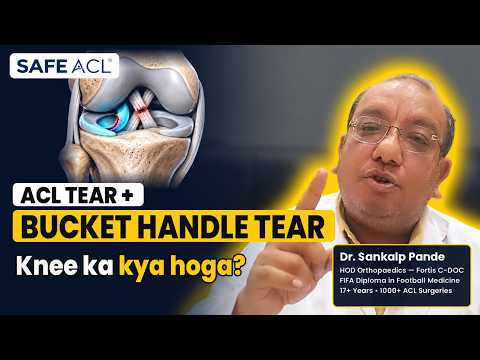 ACL tear with bucket handle meniscus tear: what happens now?An ACL tear with a bucket handle meniscus tear is treated with surgery: where possible, the torn meniscus is brought back into place and repaired while the ACL is reconstructed.
 Partial ACL tear: does it need surgery?Not every partial ACL tear needs surgery.
 Which ACL surgery technique is right for my knee?The right ACL surgery technique is the one your knee actually needs, not the one with the fanciest name or the highest price.
Consult Dr. Sankalp Pande
Consultations are at MediArbor Clinics & Diagnostics, M-21 Basement, Mandir Marg, Saket, New Delhi (Mon–Sat, 12–8 pm). Bring or WhatsApp your MRI report.
This video and page are for patient education and do not replace a consultation. Treatment is decided after examining your knee.