Partial ACL tear: does it need surgery?
Not every partial ACL tear needs surgery. Three things decide the treatment: your job, lifestyle or sport; whether the knee feels stable or gives way; and whether physio and injection made a difference after 6 weeks. Physio strengthens the muscles and an injection reduces pain, but neither joins a torn ACL. If your work or sport stresses the knee, it feels unstable and physio has not helped, the right surgery at the right time is essential.
Key points from the video
- “Partial” does not mean 50-50: a partial tear can be anywhere from 10% to 95%, so every partial tear cannot have the same treatment.
- Three things decide treatment: your job, lifestyle and sport; the actual condition of your knee; and whether physio and injection made a difference 6 weeks after the injury.
- Physio strengthens the muscles and an injection reduces pain, but neither physio nor an injection joins a torn ACL.
- A partial tear does not stay as it is: in a US study he quotes, 86% of ACLs that were three-quarters torn went on to tear completely within 7 years.
- Partial tear surgery is not like surgery for a fully torn ACL: the remaining ACL is saved and supported, not removed.
- Under SAFE ACL, his ACL treatment-planning approach, examining the knee decides who needs Jewel ACL (a synthetic ligament), who needs only support and who needs a new ligament.
- Recovery: knee fully straight from day 1, walking without support in week 1, office and driving in 3–4 weeks, running and gym at 3 months, sports at 4–7 months.
Chapters
Questions patients ask
Can physiotherapy or an injection heal a partial ACL tear?
No. Physio strengthens the muscles and an injection reduces pain, but neither physio nor an injection joins a torn ACL. The pain may reduce while the knee itself has not been fixed.
Does a partial ACL tear get worse over time?
It can. In a US study of 32 patients followed for 7 years, 50% of half-torn and 86% of three-quarters-torn ACLs tore completely. Whenever the knee slips, the meniscus and cartilage also wear away.
When does a partial ACL tear need surgery?
When your job or sport puts stress on the knee, the knee feels unstable or gives way on stairs or when turning, and physio and injection made no difference. In that case the partial tear is behaving like a full tear.
What happens in partial ACL tear surgery?
The remaining ACL is not removed; it is saved and supported. A 2025 review of studies from China found that saving it gave a more stable knee and better function, with no extra complications. Jewel ACL costs more and is not for every case.
References
- Rothrauff BB, et al. ACL consensus on treatment, outcome, and return to sport (Panther Symposium, Pittsburgh, June 2019). Knee Surg Sports Traumatol Arthrosc. 2020;28:2387–2389. doi:10.1007/s00167-020-06088-0
- Noyes FR, Mooar LA, Moorman CT, McGinniss GH. Partial tears of the anterior cruciate ligament. Progression to complete ligament deficiency. J Bone Joint Surg Br. 1989;71(5):825–833. doi:10.1302/0301-620X.71B5.2584255
- Fayard JM, Sonnery-Cottet B, Vrgoc G, et al. Incidence and Risk Factors for a Partial Anterior Cruciate Ligament Tear Progressing to a Complete Tear After Nonoperative Treatment in Patients Younger Than 30 Years. Orthop J Sports Med. 2019;7(7):2325967119856624. doi:10.1177/2325967119856624
- Chen C, et al. Remnant-preserving techniques in anterior cruciate ligament reconstruction: a systematic review and meta-analysis. BMC Surg. 2025;25:304. doi:10.1186/s12893-025-03034-0 (10 studies)
- Prospective, randomized study comparing clinical outcomes when reconstructing ACL with either semitendinosus autograft or the Jewel synthetic standalone device in two separate patient cohorts. The Knee. 2025. PubMed ID 40834676
- Sastre S, Vasquez D, González W, Balaguer-Castro M, Popescu D. Selective bundle reconstruction for partial anterior cruciate ligament tears: High return to sport, excellent long-term stability and function at 6-year follow-up. J Exp Orthop. 2025;12(4):e70509. doi:10.1002/jeo2.70509
Transcript
Read the full transcript (English translation of the Hinglish video)
With a partial ACL tear, patients get the most confused by the word "partial". First, let's understand. Your report says "partial". That doesn't mean 50-50.
A partial tear can be anywhere from 10% to 95%. So a 10% tear is also called partial, and a 90% tear is also partial. So how can every partial tear have the same treatment? In 2019, ACL experts from all over the world gathered in Pittsburgh, America, at the Panther Symposium. One of their opinions: if the knee still feels unstable after physio, or your daily life involves a lot of jumping or turning, then surgery is the better route.
So, the direct answer: three things decide what the treatment will be. First, your job, your lifestyle, and if you are a player, your sport. Second, the condition of your knee. And third, whether physio and injection made a difference or not. Let's understand them one by one.
First, let's look at your lifestyle. A desk job, walking only in a straight line, a relaxed lifestyle: in all of these, there is less stress on the knee. But if your work is physically heavy, like police, army, factory worker, construction worker, long driving, riding a bike, standing for long periods, doing gym, yoga or exercise regularly, or you play cricket, football, kabaddi, badminton, where you have to turn, twist, jump, and so the knee takes more stress, and the knee needs full strength.
The second thing: what condition your knee is in, not the percentage in the report, but the actual condition of the knee. While walking, does the knee feel stable or not? Does it feel like the knee is giving way? If the knee lets you down on stairs or when turning, then the partial tear is behaving like a full tear.
The third thing: 6 weeks after the injury, you did physio, you had the injection, and still saw no difference. These days, in many places the claim is made: 90% don't need surgery, fit with one injection. The truth is this: physio strengthens the muscles, the injection reduces pain, but neither physio nor an injection joins a torn ACL. The pain has reduced, but the knee has not been fixed. And a partial tear does not stay as it is.
Dr Frank Noyes from America followed 32 patients, whose partial tear was confirmed on arthroscopy, for 7 years. Of those whose ACL was one-fourth torn, a full tear happened in few, of those whose ACL was half torn, 50% went on to tear completely, and of those whose ACL was 3/4 torn, 86% tore completely. And this is not old news. In 2019, Dr Fayard's team in France followed 41 active patients under 30 years of age without surgery. In about 3.5 years, the ACL tore completely in 4 out of every 10, and in 50% of those, the meniscus had also torn. In patients with a partial ACL tear, whenever the knee slips, the meniscus and cartilage also wear away.
The good news: partial tear surgery is not like surgery for a fully torn ACL. Pioneer surgeons like Dr Bertrand Sonnery-Cottet of France have shown: don't remove the remaining ACL, save it and support it. In 2025, Dr Chunrong Chen's team from China, combining many studies, found that in everyone whose partial ACL was saved, the knee was more stable, function was better and there were no extra complications, because the remaining ACL has nerves and blood supply, which help to keep the knee stable.
In this, there is one option, Jewel ACL, a synthetic ligament that is made in the UK. It is fitted along with the remaining ACL, no graft is taken from your body, and it gives strength from day 1. Yes, it costs more and it is not for every case. Who gets Jewel ACL, who needs only support, and who needs a new ligament, is decided by examining the knee.
This is SAFE ACL, the latest approach, in which surgery is planned by looking at your knee. In recovery, we follow international standards and protocols, the same ones that the world's pioneer ACL surgeons follow. From day 1, straightening the knee fully; in week 1, walking without support; in week 2, walking normally; in 3-4 weeks, office, daily activities and driving; in 3 months, running and gym; in 4-7 months, back to playing sports. And if Jewel ACL is used, return to running, gym and sport in 2-3 months, but only when the knee muscle strength is equal to the other leg.
And after surgery, what next? Dr Sergi Sastre's team in Barcelona, Spain, followed patients who had partial ACL surgery for 6 years: the knee stayed stable, most returned to sport, and re-injury was very rare. In a partial ACL tear, not everyone needs surgery, but for those whose job or sport puts stress on the knee, whose knee feels unstable, and who saw no difference even after physio and injection, the right surgery at the right time is essential.
If your MRI shows a partial tear and your knee is still not right, send your report on WhatsApp, and we will look and tell you what your knee needs. The number is on the screen and in the description. Thank you.
Read next
Patient guide: Does an ACL Tear Need Surgery?
 ACL and meniscus tear: what surgery and recovery should I expect?An ACL tear with a meniscus tear is treatable with one keyhole surgery that reconstructs the ACL and, where possible, repairs the meniscus, followed by step-by-step rehabilitation starting with knee exercises from day 1.
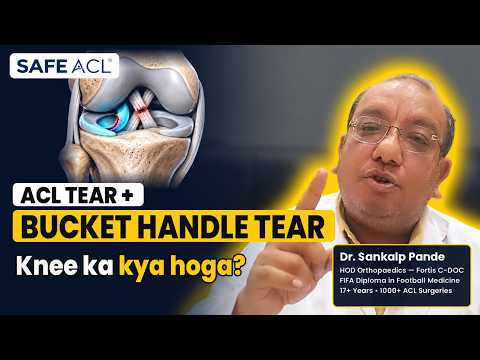 ACL tear with bucket handle meniscus tear: what happens now?An ACL tear with a bucket handle meniscus tear is treated with surgery: where possible, the torn meniscus is brought back into place and repaired while the ACL is reconstructed.
 Which ACL surgery technique is right for my knee?The right ACL surgery technique is the one your knee actually needs, not the one with the fanciest name or the highest price.
Consult Dr. Sankalp Pande
Consultations are at MediArbor Clinics & Diagnostics, M-21 Basement, Mandir Marg, Saket, New Delhi (Mon–Sat, 12–8 pm). Bring or WhatsApp your MRI report.
This video and page are for patient education and do not replace a consultation. Treatment is decided after examining your knee.